
Hormonal Acne in Adults: Why Pimples Keep Coming Back After 25
You thought acne was something you would leave behind in your teenage years. But now, in your late 20s or 30s, those stubborn pimples keep appearing on your chin, jawline, or cheeks. Sometimes they show up just before your period, while other times they seem to appear without any obvious reason.
If this sounds familiar, you may be dealing with hormonal acne in adults.
Adult acne is more common than many people realise. While hormonal changes can contribute to recurring breakouts, genetics, skincare habits, stress, and certain medical conditions may also play a role.
The challenge is that repeatedly treating individual pimples may not be enough when new breakouts keep developing. Understanding the possible triggers and choosing a suitable treatment plan can make a meaningful difference.
At Aesthira Aesthetic, Indirapuram, Ghaziabad, personalised skin consultations help individuals better understand concerns such as persistent acne, uneven skin texture, and post-acne marks.
In this guide, we explain why acne appears after 25, the signs of possible hormonal acne, its connection with PCOS, and the treatment options that can help manage recurring breakouts.
What Is Hormonal Acne?
Hormonal acne refers to acne influenced by changes in hormone activity, particularly androgens, which can increase oil production in the skin.
Excess oil, dead skin cells, clogged pores, and inflammation contribute to the formation of pimples, whiteheads, blackheads, and deeper acne lesions.
Although hormonal influences are commonly associated with puberty, they can also contribute to acne during adulthood.
Adult women may experience changes in acne activity around their menstrual cycle, during pregnancy, or around menopause.
Hormonal acne is not a separate diagnosis that can be confirmed simply by looking at where pimples appear. A clinician considers the pattern of breakouts, medical history, associated symptoms, and other possible causes before recommending treatment.
What Does Hormonal Acne Look Like?
Possible signs include:
- Repeated pimples around the chin and jawline
- Breakouts that worsen before menstruation
- Deep, tender, or painful acne lesions
- Recurring pimples in similar areas
- Persistent acne despite changes in skincare products
- Acne that continues into the late 20s, 30s, or beyond
However, these signs are not exclusive to hormonal acne. Other forms of adult acne can produce similar symptoms.
Why Does Acne Appear After 25 or 30?
One of the most common questions adults ask is, “Why am I still getting pimples when I am no longer a teenager?”
The answer is that acne does not have an age limit.
Some individuals continue experiencing acne from adolescence, while others develop breakouts for the first time during adulthood.
Several factors may contribute to acne after 25.
1. Hormonal Fluctuations
Hormones influence how much sebum, or natural oil, the skin produces.
Androgens can stimulate the sebaceous glands, contributing to clogged pores and inflammatory acne.
Hormonal fluctuations associated with menstrual cycles, pregnancy, and other life stages may affect acne activity.
Importantly, hormonal sensitivity can contribute to breakouts even when routine hormone test results are within normal ranges.
2. Genetics and Family History
If your parents or siblings experienced persistent adult acne, you may have a greater tendency to develop similar concerns.
Genetics can influence oil production, inflammation, and individual susceptibility to acne.
3. Stress and Lifestyle Changes
Stress may contribute to acne flare-ups through changes in hormonal and inflammatory responses.
However, stress is rarely the only cause.
Sleep disruption and changes in daily routines may also affect how consistently you care for your skin.
4. Skincare and Cosmetic Products
Heavy or pore-clogging cosmetics, unsuitable moisturisers, and certain hair products may contribute to breakouts.
Using several exfoliating acids or acne treatments together may also irritate the skin.
A complicated skincare routine is not necessarily a better routine.
5. Certain Medications
Some medications may cause or worsen acne-like eruptions.
If your acne appeared after starting a new medicine, discuss it with the prescribing clinician rather than stopping the medication yourself.
6. Underlying Health Conditions
In some individuals, persistent acne may be associated with hormonal conditions such as polycystic ovary syndrome (PCOS).
However, most adult acne does not automatically indicate an underlying endocrine disorder.
A complete assessment helps determine whether additional medical evaluation is needed.
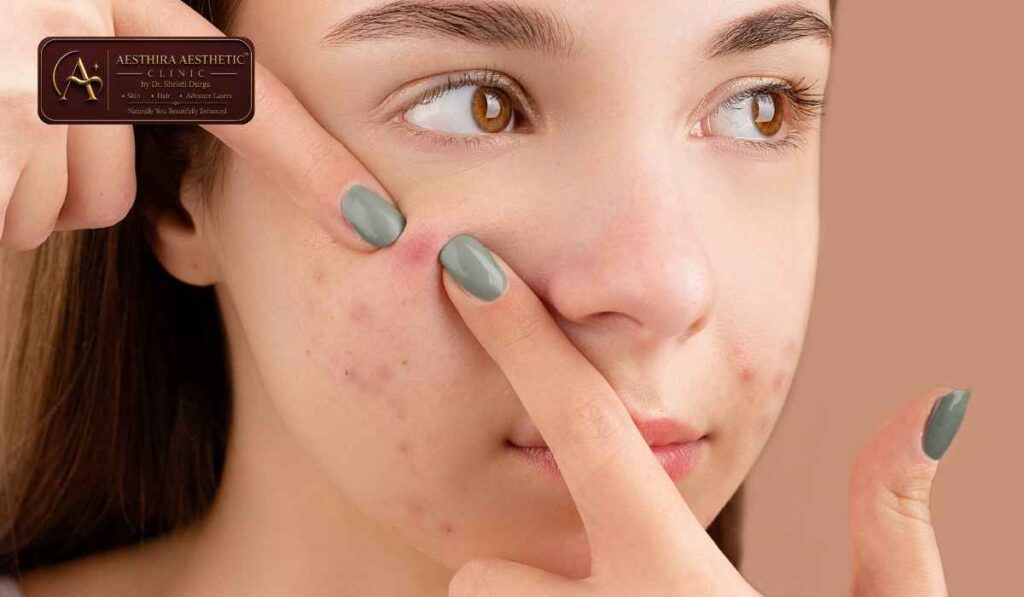
What Are the Signs of Possible Hormonal Acne in Adults?
Hormonal acne can resemble other types of acne, but certain patterns may suggest that hormones are contributing to the breakouts.
Repeated Jawline Acne
Jawline acne is commonly discussed in relation to hormonal breakouts.
Some adults experience deep, painful pimples along the lower cheeks and jawline.
However, jawline acne does not always mean you have a hormonal imbalance. Other factors, including ordinary acne mechanisms, friction, and pore-clogging products, may contribute.
Chin Acne in Women
Recurring chin acne in women may be associated with menstrual fluctuations.
These breakouts can appear as inflamed bumps, pustules, or deeper nodules.
If the same area repeatedly develops acne, it is worth assessing the overall breakout pattern rather than treating each pimple individually.
Breakouts Before Your Period
Some women notice that acne becomes more noticeable several days before menstruation.
Changes in hormone levels during the menstrual cycle may influence sebum production and inflammatory responses.
Tracking when breakouts occur can help identify a recurring pattern.
Deep and Painful Pimples
Unlike small surface-level whiteheads, some adult acne lesions develop deeper within the skin.
These can feel tender and may remain visible for longer.
Deep inflammatory acne is particularly important to manage because it increases the risk of post-acne marks and scarring.
Recurring Pimples on the Face
If you experience recurring pimples on your face despite following a skincare routine, the underlying acne may not be adequately controlled.
Repeatedly switching products can make the situation more difficult by causing additional irritation.
Hormonal Acne vs Other Adult Acne: What’s the Difference?
Not all acne that develops after 25 is hormonal.
Adult acne can result from several overlapping factors, and a person’s breakout pattern does not always reveal the complete cause.
| Feature | Possible Hormonal Influence | Other Common Acne Factors |
| Timing | May worsen around menstrual periods | May be persistent or associated with products and other triggers |
| Location | Often involves the lower face | Can affect the forehead, cheeks, chin, jawline, chest, or back |
| Appearance | May include deep inflammatory pimples | May include blackheads, whiteheads, papules, or pustules |
| Associated symptoms | Sometimes occurs with irregular periods or excess facial hair | May occur without other hormonal symptoms |
| Diagnosis | Requires clinical assessment of the overall pattern | Requires evaluation of acne severity and contributing factors |
| Treatment | May benefit from hormonal therapy in selected patients | Often responds to standard evidence-based acne treatments |
The key difference is not simply the location of the pimples.
For example, acne around the chin may be hormonally influenced, but chin acne alone cannot confirm a hormonal condition.
Similarly, acne on the forehead does not rule out a hormonal contribution.
A suitable treatment plan should be based on the complete clinical picture.
Can PCOS Cause Hormonal Acne?
Yes. Polycystic ovary syndrome, or PCOS, can contribute to acne in some women.
PCOS is a hormonal and metabolic condition that can affect menstrual cycles, ovulation, and androgen activity.
Increased androgen activity may stimulate the skin’s oil glands, making acne more persistent.
However, having hormonal acne does not necessarily mean you have PCOS.
Acne on its own is a relatively weak indicator of PCOS. Other symptoms and clinical findings are important.
Signs That May Suggest PCOS
Some women with PCOS may experience:
- Irregular or infrequent menstrual periods
- Persistent acne
- Increased facial or body hair growth
- Hair thinning on the scalp
- Difficulty with weight management
- Problems with ovulation or fertility
Not every woman with PCOS experiences all these symptoms.
When Should You Consider a PCOS Evaluation?
If recurring acne occurs alongside irregular menstrual periods, increased facial hair, or scalp hair thinning, a doctor may recommend further assessment.
Depending on the clinical history, this may involve selected hormone tests and other investigations.
Routine hormonal blood tests are not necessary for every adult experiencing acne.
Can Treating PCOS Improve Acne?
For individuals whose acne is associated with PCOS, managing the underlying condition may help improve skin symptoms.
However, specific acne treatments may still be necessary.
A coordinated approach involving appropriate medical care and skincare can be beneficial.
What Are the Best Treatments for Hormonal Acne in Adults?
The most effective hormonal acne treatment depends on acne severity, skin type, medical history, pregnancy considerations, and whether hormonal factors are likely to contribute.
There is no single treatment that works for everyone.
Evidence-based acne management commonly involves topical treatments, while some patients require prescription medication.
1. Benzoyl Peroxide
Benzoyl peroxide is a well-established acne treatment that helps reduce acne-associated bacteria and inflammation.
It may be useful for inflammatory pimples.
However, some individuals experience dryness, irritation, or peeling, particularly when introducing it too quickly or combining it with other irritating products.
A clinician can help determine the appropriate formulation and application schedule.
2. Topical Retinoids
Topical retinoids, including adapalene and tretinoin, help regulate the shedding of skin cells and reduce clogged pores.
They are commonly used to manage comedonal and inflammatory acne.
Results usually develop gradually with consistent use.
Because retinoids can cause irritation and are generally avoided during pregnancy or when planning pregnancy, treatment suitability should be discussed with a qualified clinician.
3. Azelaic Acid
Azelaic acid may be useful for certain forms of acne and post-inflammatory hyperpigmentation.
It can be particularly relevant for individuals who experience both active pimples and dark marks after breakouts.
The most suitable concentration and routine depend on skin tolerance and individual needs.
4. Salicylic Acid
Salicylic acid helps exfoliate within pores and may improve blackheads, whiteheads, and some mild acne concerns.
However, using multiple salicylic acid products or combining them with several other exfoliating ingredients can irritate sensitive skin.
More frequent exfoliation does not always mean faster acne improvement.
5. Hormonal Medicines Prescribed by a Clinician
Some women with persistent adult acne may benefit from hormonal treatments.
Depending on suitability and medical history, a qualified prescriber may consider combined oral contraceptive pills or spironolactone.
These medications can help reduce androgen-related effects on acne in selected patients.
They are not suitable for everyone and require consideration of contraindications, side effects, other medicines, and pregnancy risks.
Do not start hormonal medicines solely on the basis of chin or jawline breakouts.
6. Prescription Treatments for Moderate or Severe Acne
Some patients require additional prescription therapy, particularly when acne is widespread, painful, scarring, or resistant to initial treatment.
A qualified dermatologist may consider appropriate topical combinations, short courses of oral antibiotics alongside topical treatment, or isotretinoin for selected severe cases.
These treatments require individual medical assessment and monitoring.
Can Chemical Peels Help Adult Hormonal Acne?
Chemical peels may be considered as an additional treatment for selected acne-related concerns.
They involve applying a carefully selected exfoliating solution to the skin.
Depending on the peel and the individual’s skin condition, chemical peels may help improve clogged pores, superficial skin texture, and certain post-acne marks.
However, chemical peels do not correct the hormonal factors that may contribute to acne.
They should not replace appropriate medical management of persistent inflammatory acne.
When Might Chemical Peels Be Considered?
A clinician may assess whether a peel is appropriate for:
- Selected mild acne concerns
- Superficial clogged pores
- Post-inflammatory pigmentation
- Uneven skin tone after acne
- Certain texture irregularities
People with very inflamed or irritated skin may need other treatment first.
Aesthira Aesthetic offers chemical peel treatments in Indirapuram, with treatment suitability depending on individual skin assessment.
Can LED Light Therapy Help With Adult Acne?
LED light therapy uses specific wavelengths of light as a non-invasive skin treatment.
Certain light-based approaches, particularly blue and red light, have been studied for inflammatory acne.
However, clinical results vary according to the device, treatment protocol, and acne severity.
Current evidence is not strong enough to consider LED therapy a replacement for established first-line acne treatments.
What Are the Potential Benefits?
In selected individuals, LED light therapy may be considered as an adjunct to acne management.
Its potential role includes:
- Supporting improvement in some inflammatory acne lesions
- Offering a non-invasive treatment option
- Complementing an appropriate skincare or medical treatment plan
LED therapy does not treat PCOS or correct underlying hormonal changes.
Learn more about LED Light Therapy at Aesthira Aesthetic.
Why Does Hormonal Acne Keep Coming Back Even After Treatment?
Recurring acne can be frustrating, particularly when the skin appears clear for a few weeks before new pimples develop.
There are several possible explanations.
The Underlying Triggers May Still Be Present
Some people remain susceptible to breakouts because of ongoing hormonal influences, genetics, or increased sebum production.
A treatment may clear existing lesions without completely eliminating the tendency to develop new ones.
Treatment May Have Been Stopped Too Early
Many acne treatments require several weeks before meaningful improvement becomes visible.
Stopping medication as soon as existing pimples disappear may contribute to recurrence in people who need maintenance treatment.
The Skincare Routine May Be Irritating
Frequent exfoliation, harsh cleansers, and unsuitable cosmetic products can irritate acne-prone skin.
Using more active ingredients is not always better.
Active Acne May Not Be Adequately Controlled
If new inflammatory lesions keep developing, the existing treatment plan may need reassessment.
This is particularly important when breakouts are painful or are leaving scars.
What Skincare Habits Can Make Adult Acne Worse?
A skincare routine should support acne treatment, not continuously irritate the skin.
Some everyday habits may worsen breakouts or make acne harder to manage.
1. Picking or Squeezing Pimples
Picking can increase inflammation, prolong healing, and raise the risk of pigmentation and scarring.
2. Excessive Exfoliation
Using scrubs, peels, and several exfoliating acids too frequently can damage the skin barrier and cause irritation.
3. Changing Skincare Products Too Often
Most acne treatments need time to work.
Constantly switching products may cause irritation before you can assess whether a treatment is effective.
4. Using Pore-Clogging Products
Some moisturisers, foundations, and hair products may contribute to acne in susceptible individuals.
Choosing products labelled non-comedogenic may be helpful.
5. Skipping Moisturiser
Even oily, acne-prone skin needs appropriate hydration.
Dryness and irritation from acne medications can make treatment harder to tolerate.
6. Ignoring Sunscreen
Inflammatory acne can leave dark marks, especially in pigmentation-prone skin.
A suitable broad-spectrum sunscreen helps protect the skin and reduce the worsening of post-inflammatory pigmentation.
What Is a Simple Skincare Routine for Adult Acne?
A consistent routine does not have to involve ten different products.
For many adults, a gentle skincare foundation is a useful starting point.
Morning Skincare Routine
Step 1: Gentle cleanser
Wash your face with a mild cleanser that removes excess oil without leaving the skin feeling tight or irritated.
Step 2: Prescribed or recommended acne treatment
Use any morning acne product according to professional guidance.
Step 3: Non-comedogenic moisturiser
Choose a moisturiser suited to your skin type.
Step 4: Sunscreen
Apply broad-spectrum SPF 30 or higher, particularly when spending time outdoors.
Night Skincare Routine
Step 1: Remove makeup and sunscreen
Cleanse gently without scrubbing.
Step 2: Apply prescribed treatment
Use your clinician-recommended acne medication according to its instructions.
Step 3: Moisturise
Maintain skin hydration and minimise unnecessary irritation.
Avoid introducing multiple strong active ingredients together without guidance.
How Long Does Hormonal Acne Take to Improve?
Hormonal acne treatment requires consistency and patience.
Some individuals notice initial improvement after approximately 6–8 weeks of appropriate treatment.
More substantial improvement may take several months, depending on acne severity and the treatment selected.
Hormonal medicines may also require several months before their full benefit becomes apparent.
Why Are Results Different for Everyone?
Treatment response may depend on:
- Acne severity
- Individual hormonal influences
- Skin sensitivity
- Adherence to the treatment plan
- Ongoing breakouts
- Associated medical conditions
- Previous treatment history
The objective is to achieve sustained acne control, reduce new inflammatory lesions, and minimise the risk of scarring.
If there is little improvement after an appropriate treatment period, reassessment may be necessary.
Can Hormonal Acne Leave Dark Marks and Scars?
Yes. Adult hormonal acne can leave post-inflammatory marks and permanent scars, especially when breakouts are deep or repeatedly inflamed.
Dark Marks After Acne
Post-inflammatory hyperpigmentation occurs when inflammation triggers increased pigment production.
These marks are typically flat and may appear brown or darker than the surrounding skin.
They can be particularly noticeable in medium and deeper Indian skin tones.
Acne Scars
Deep inflammatory acne may damage the underlying skin structure, causing depressed or raised scars.
Acne scars do not generally respond to ordinary brightening skincare in the same way as flat pigmentation.
Why Should Active Acne Be Treated First?
Controlling new breakouts helps prevent additional marks and scars from forming.
Once active acne is appropriately managed, persistent pigmentation or scarring can be assessed separately.
For concerns involving acne-related marks and texture changes, explore Acne & Acne Scar Management at Aesthira Aesthetic.
When Should You Consult a Qualified Clinician for Adult Acne?
Occasional mild breakouts may improve with suitable skincare.
However, persistent or recurring acne should not be ignored, particularly when it affects comfort, confidence, or skin texture.
Consider professional assessment if:
- You develop painful or deep acne nodules.
- Your acne repeatedly leaves dark marks or scars.
- Breakouts continue despite an appropriate treatment routine.
- Acne suddenly becomes severe during adulthood.
- You have recurring acne with irregular periods or unwanted facial hair.
- Your skincare products repeatedly cause significant irritation.
- You are considering prescription or hormonal acne medication.
- Acne is affecting your emotional well-being.
Early assessment can help identify the problem and reduce the risk of ongoing skin damage.
How Is Adult Acne Assessed at Aesthira Aesthetic in Indirapuram?
Understanding why pimples keep returning is an important part of choosing a treatment approach.
At Aesthira Aesthetic, skin consultations and assessment services can help individuals better understand their acne-related concerns.
Step 1: Understanding Your Acne History
A consultation may begin with questions about when the acne started, how frequently breakouts occur, and which treatments you have already tried.
Where relevant, menstrual patterns, medications, and associated symptoms may also need to be discussed with a qualified medical professional.
Step 2: Assessing Your Skin
Aesthira Aesthetic offers advanced skin analysis and consultation to support the evaluation of visible skin concerns.
A clinical examination is still important for assessing acne severity, lesion types, and possible scarring.
Step 3: Identifying Contributing Factors
The assessment can help distinguish common acne patterns from other concerns.
If symptoms suggest an underlying hormonal condition, an appropriately qualified doctor may recommend additional medical evaluation.
Step 4: Discussing Suitable Treatment Options
Based on the individual’s skin concerns, available options may include supportive skincare, appropriate professional treatments, and referral for prescription-based medical care when needed.
Step 5: Monitoring Progress
Because acne management often takes several weeks or months, follow-up can help assess whether the treatment approach is effective and whether adjustments are needed.
Why Choose Aesthira Aesthetic for Acne Treatment in Indirapuram?
If you are dealing with recurring pimples, persistent adult acne, or post-acne marks, choosing a clinic that offers individual skin assessment can help you make more informed treatment decisions.
Aesthira Aesthetic is a skin, hair, and aesthetic clinic in Indirapuram, Ghaziabad, offering a range of skin-focused consultation and treatment services.
1. Personalised Skin Consultations
Aesthira Aesthetic emphasises understanding individual skin concerns before discussing suitable treatment options.
This is particularly relevant because not every case of adult acne is caused by hormonal imbalance.
2. Advanced Skin Analysis
The clinic offers advanced skin analysis services that can support the assessment of visible concerns such as acne, uneven skin texture, and pigmentation.
These tools can complement, but do not replace, a qualified clinical examination.
3. Multiple Skin Treatment Services
Aesthira Aesthetic offers services including:
- Acne and acne scar management
- Chemical peels
- LED light therapy
- Pigmentation management
- Advanced skin analysis and consultation
Treatment suitability depends on individual skin needs and clinical assessment.
4. Focus on Individual Skin Concerns
Adult acne may occur alongside sensitivity, pigmentation, or previous acne scarring.
Addressing these concerns requires careful planning rather than automatically recommending the same treatment for everyone.
5. Convenient Location in Indirapuram
For people looking for acne treatment in Indirapuram, Aesthira Aesthetic provides a local option to enquire about skin consultations and available aesthetic services.
Where prescription medication or hormonal investigations are needed, these should be managed by appropriately qualified medical professionals.
Final Thoughts: Adult Acne Can Be Managed With the Right Approach
Experiencing acne after 25 or 30 can be frustrating, especially when the same pimples keep returning despite your efforts.
But recurring adult acne does not necessarily mean your skincare routine is failing or that you have a hormonal disorder.
Hormonal acne in adults is influenced by several possible factors, and successful management begins with understanding the individual pattern of breakouts.
For some people, suitable topical treatments are enough. Others may benefit from prescription medicines or evaluation of associated hormonal concerns.
Professional treatments such as chemical peels and LED light therapy may have a supportive role in selected cases, but they should complement rather than replace appropriate acne management.
The most important goal is not simply to clear one breakout. It is to reduce future breakouts, protect skin health, and minimise the risk of lasting marks and scars.
Book Your Skin Consultation at Aesthira Aesthetic
Are you struggling with recurring pimples, jawline acne, chin acne, or acne marks that will not fade?
At Aesthira Aesthetic, you can enquire about skin consultations and personalised treatment options for adult acne and related skin concerns.
Take the first step towards understanding your skin and making an informed treatment decision.
Clinic: Aesthira Aesthetic, Indirapuram, Ghaziabad
Website: www.aesthiraaesthetic.com
Book an Appointment: Contact Aesthira Aesthetic
Frequently Asked Questions
1. Why am I getting acne at 30?
Acne can continue or develop for the first time during adulthood. Hormonal fluctuations, genetics, stress, certain medications, and skincare products may contribute. Acne after 30 does not automatically indicate a hormonal disorder. Persistent or painful breakouts should be assessed professionally.
2. What are the signs of hormonal acne?
Possible signs include recurring chin or jawline acne, deep inflammatory pimples, and breakouts that worsen before menstruation. However, these patterns cannot confirm hormonal acne on their own. A clinician considers your full medical history and associated symptoms.
3. Is chin acne always hormonal?
No. Chin acne in women may be influenced by hormonal fluctuations, but it can also occur because of common acne mechanisms, pore-clogging products, or other factors. The location of pimples alone cannot determine their cause.
4. Can PCOS cause recurring pimples?
Yes. PCOS can contribute to acne through increased androgen activity. However, acne alone does not establish a PCOS diagnosis. Irregular periods, excess facial hair, and scalp hair thinning may indicate a need for further evaluation.
5. Why does acne worsen before my period?
Hormonal fluctuations during the menstrual cycle may affect oil production and inflammation. Some women notice more pimples shortly before menstruation. Tracking your breakouts over several cycles may help identify whether they follow a recurring pattern.
6. Can hormonal acne occur with normal hormone tests?
Yes. Some individuals experience acne influenced by hormonal activity even when measured hormone levels are within normal ranges. The skin’s sensitivity to androgens can also play a role. Routine hormone testing is not necessary for every person with adult acne.
7. Are chemical peels suitable for hormonal acne?
Chemical peels may help selected acne-related concerns, such as clogged pores and post-inflammatory pigmentation. However, they do not correct underlying hormonal factors and are not a substitute for evidence-based acne treatment. Suitability depends on acne severity and skin condition.
8. Does hormonal acne leave dark marks?
Yes. Inflammatory acne can leave post-inflammatory hyperpigmentation, particularly in pigmentation-prone skin. Deep acne may also cause scarring. Controlling active acne and using suitable sun protection can help reduce the development and worsening of post-acne marks.
9. What should I do if adult acne keeps returning?
Avoid repeatedly switching skincare products or squeezing pimples. Follow a consistent, gentle routine and consult a qualified clinician if breakouts persist. You may need an individualised treatment plan, especially if acne is painful, scarring, or associated with other hormonal symptoms.
10. Where can I get an adult acne assessment in Indirapuram?
You can enquire about skin consultations and acne-related aesthetic services at Aesthira Aesthetic, Indirapuram, Ghaziabad. The clinic offers advanced skin analysis, acne management services, chemical peels, and LED light therapy. Visit aesthiraaesthetic.com or the contact page for appointment information.