Acne Marks vs Acne Scars: How to Identify and Treat Each
Acne may disappear after a few days or weeks, but sometimes it leaves something behind—dark spots, red marks, or uneven skin texture. If you have ever noticed these changes after a breakout, you may have wondered whether they are acne marks or permanent acne scars.
Although the terms are often used interchangeably, acne marks vs acne scars are two different skin concerns. Understanding the difference is important because each requires a different treatment approach.
While acne marks usually involve changes in skin colour, acne scars affect the skin’s texture and structure. The good news is that both can often be improved with appropriate skincare, professional treatments, and consistent care.
At Aesthira Aesthetic, Indirapuram, Ghaziabad, skin consultations focus on understanding individual concerns before recommending suitable treatment options.
In this guide, we will explain how to identify acne marks and scars, why they develop, which treatments may help, and when professional skin assessment is recommended.
What is the Difference Between Acne Marks and Acne Scars?
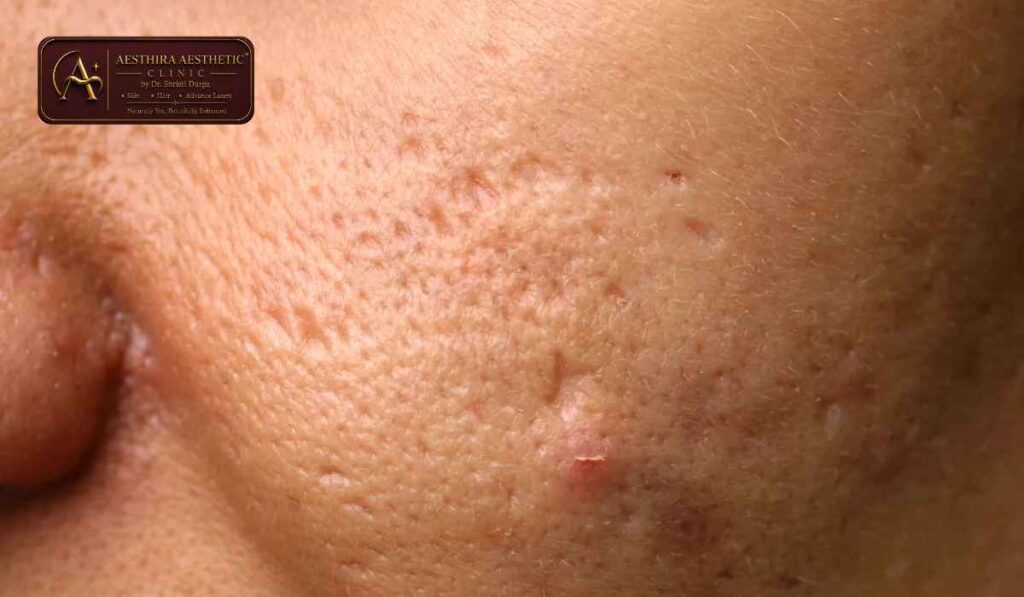
The main difference between acne marks and acne scars is how they affect the skin. Acne marks are usually flat areas of discolouration left after inflammation, while acne scars involve changes in skin texture, such as depressions or raised areas. Acne marks may gradually fade, whereas true scars generally require professional treatment for noticeable improvement.
Acne Marks vs Acne Scars: Quick Comparison
| Feature | Acne Marks | Acne Scars |
| Appearance | Flat, red, pink, brown, or dark spots | Pits, depressions, or raised areas |
| Skin texture | Usually remains smooth | Becomes uneven |
| Main cause | Changes in pigmentation or blood vessels after inflammation | Changes in collagen during healing |
| Natural fading | Often fade gradually | Usually persist without treatment |
| Common concerns | Dark spots after pimples, red marks | Ice-pick, boxcar, rolling, or raised scars |
| Treatment approach | Skincare, sun protection, selected chemical peels | Microneedling and other scar-specific procedures |
| Recovery | Depends on pigmentation depth and individual skin response | Improvement generally requires multiple treatments |
A simple way to understand the difference is to look at your skin in natural light.
If you can see a dark spot but your skin feels smooth, it may be an acne mark. If the area looks indented, raised, or uneven, it may be an acne scar.
However, some people have both acne marks and scars in the same area, making a professional assessment helpful.
What Are Acne Marks?
Acne marks are areas of skin discolouration that develop after a pimple or inflammatory breakout has healed.
When acne causes inflammation, the skin’s healing process can affect pigment production or superficial blood vessels. As a result, a visible spot may remain even after the pimple disappears.
Unlike true acne scars, most acne marks do not permanently change the skin’s texture.
1. Post-Inflammatory Hyperpigmentation (PIH)
Post-inflammatory hyperpigmentation occurs when inflammation triggers excess melanin production.
These marks commonly appear as:
- Brown spots after pimples
- Dark patches on the cheeks or forehead
- Uneven skin tone around previous breakouts
- Persistent pigmentation after inflammatory acne
PIH is particularly common in medium and deeper skin tones, including many Indian skin types.
2. Post-Inflammatory Erythema (PIE)
Post-inflammatory erythema refers to lingering redness associated with superficial blood-vessel changes after inflammation.
It may appear as pink, red, or reddish-purple marks, especially in lighter skin tones.
Unlike PIH, which involves excess pigmentation, PIE is primarily associated with vascular changes.
The distinction matters because treatments targeting pigmentation may not be equally effective for persistent redness.
3. Dark Spots After Pimples
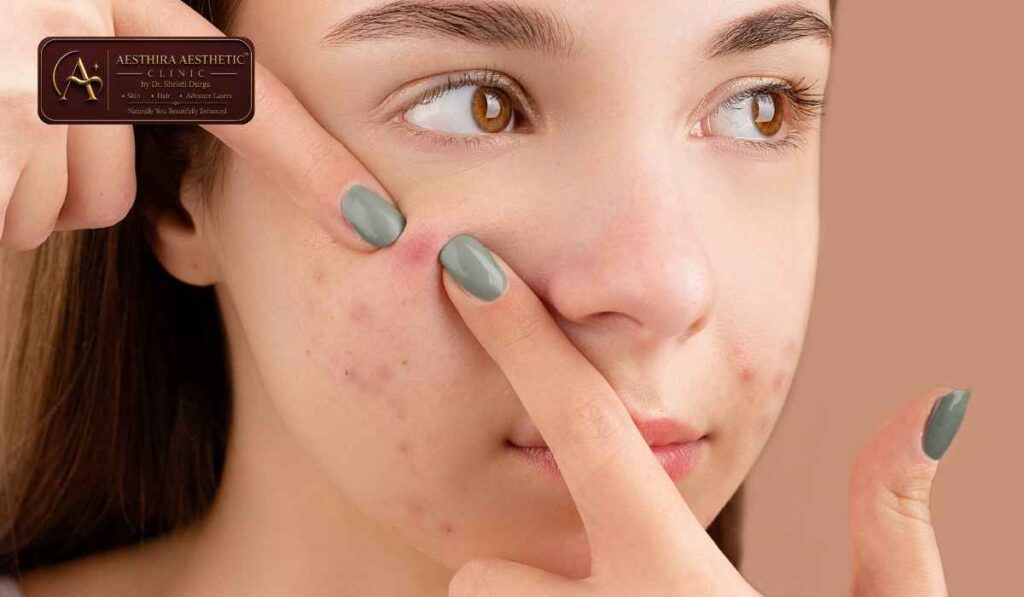
Dark spots after pimples are one of the most common reasons people seek pigmentation treatments.
Picking pimples, repeated inflammation, and unprotected sun exposure can make these marks more noticeable or slower to fade.
For many people, the primary concern is not active acne but the uneven complexion left behind.
If you are experiencing persistent dark spots, professional pigmentation treatment may help determine the most suitable approach.
What Are Acne Scars?
Acne scars form when inflammation damages the skin’s supporting tissue and disrupts normal collagen production during healing.
If the skin produces insufficient collagen, a depressed scar may develop. Excessive collagen production can cause a raised scar.
Unlike acne marks, these changes affect the skin’s structure rather than colour alone.
1. Ice-Pick Acne Scars
Ice-pick scars are small, narrow, and often deep depressions in the skin.
They resemble tiny punctures and may appear on the cheeks and other acne-prone areas.
Because these scars extend deeper into the skin, they can be challenging to treat using surface-level treatments alone.
2. Boxcar Acne Scars
Boxcar scars are round or oval depressions with relatively defined edges.
They may be shallow or deep and commonly appear on the cheeks and temples.
Depending on their depth, suitable scar treatments may help make them less noticeable.
3. Rolling Acne Scars
Rolling scars create broad, shallow depressions that give the skin a wavy or uneven appearance.
Some rolling scars are attached to deeper tissue by fibrous bands, which can pull the skin downward.
Their treatment may require procedures that address both the scar’s surface and its underlying attachments.
4. Raised Acne Scars
Raised scars develop when the skin produces excessive collagen while healing.
Two important types are hypertrophic scars and keloids.
Hypertrophic scars remain within the original injury area, while keloids can grow beyond it.
These scars require a different treatment approach from depressed acne scars. Procedures such as routine microneedling may be unsuitable for individuals with certain raised scars or a history of keloid formation.
Why Do Some Pimples Leave Marks While Others Leave Scars?
Not everyone who experiences acne develops lasting marks or scars.
Several factors can influence how the skin heals after a breakout.
Severity of Acne
Deep, painful acne lesions, including nodules and cysts, are more likely to damage the surrounding tissue and cause scarring.
Picking or Squeezing Pimples
Squeezing pimples can increase inflammation and damage skin tissue.
It can also increase the risk of pigmentation changes and scarring.
Individual Skin Response
Some people are naturally more prone to post-inflammatory hyperpigmentation or abnormal scar formation.
Genetics, skin tone, and the body’s healing response can influence the outcome.
Delayed Acne Treatment
Persistent inflammatory acne increases the possibility of developing additional marks and scars.
Managing active acne early can help reduce the risk of new skin damage.
Sun Exposure
Sunlight can make existing post-acne pigmentation more noticeable and delay improvement.
Consistent sun protection is therefore an important part of managing dark acne marks.
Can Acne Marks Fade Naturally?
Yes, many acne marks can gradually fade as the skin recovers from inflammation.
However, the time required depends on the depth of pigmentation, the severity of the original inflammation, ongoing breakouts, and sun exposure.
How Long Do Acne Marks Take to Fade?
Mild post-inflammatory pigmentation may improve over several months.
Some dark spots take approximately 6–12 months to fade, while deeper pigmentation may last considerably longer.
Persistent redness can follow a different recovery pattern.
The important point is that improvement is often gradual. Using multiple aggressive skincare products in an attempt to remove marks quickly may cause irritation and make pigmentation worse.
How to Help Acne Marks Fade
A simple, consistent skincare routine may help support recovery:
- Daily sunscreen: Use a broad-spectrum sunscreen with SPF 30 or higher. Tinted options containing iron oxides may provide additional protection against visible light, which can worsen certain pigmentation concerns.
- Gentle cleansing: Avoid harsh scrubs and excessive exfoliation.
- Suitable moisturiser: Maintain skin hydration and reduce unnecessary irritation.
- Targeted skincare ingredients: Products containing ingredients such as azelaic acid, retinoids, vitamin C, or niacinamide may be useful for selected individuals.
- Active acne control: Treating ongoing breakouts helps prevent new marks from developing.
Not every ingredient is suitable for every skin type. A clinician can recommend products based on skin sensitivity, active acne, and pigmentation severity.
Do Acne Scars Fade Naturally?
True acne scars generally do not disappear naturally in the same way that flat pigmentation marks may fade.
Some scars can become less noticeable over time, but depressed and raised scars often remain because the skin’s underlying structure has changed.
Professional treatment aims to improve their appearance rather than guarantee complete removal.
The most appropriate approach depends on scar type, depth, skin tone, medical history, and expected treatment response.
Which Treatments Work Best for Acne Marks vs Acne Scars?
There is no single treatment that works equally well for every type of post-acne mark or scar.
Some treatments focus on excess pigmentation, while others encourage collagen remodelling or address structural changes beneath the skin.
1. Chemical Peels for Acne Marks
Chemical peels use carefully selected exfoliating solutions to remove or renew superficial skin layers.
Depending on the formulation and individual skin condition, they may help improve:
- Post-acne hyperpigmentation
- Uneven skin tone
- Superficial texture irregularities
- Certain forms of acne and clogged pores
Chemical peels are often considered for pigmentation concerns rather than deep, pitted acne scars.
Peel selection, concentration, frequency, and aftercare are important, especially for pigmentation-prone skin.
Learn more about chemical peel treatments at Aesthira Aesthetic.
2. Microneedling for Acne Scars
Microneedling is a minimally invasive procedure that uses fine needles to create controlled micro-injuries in the skin.
This stimulates the skin’s repair response and encourages collagen production.
Over time, collagen remodelling may improve the appearance of selected depressed acne scars and uneven skin texture.
Microneedling is commonly considered for certain rolling and boxcar scars, although its effectiveness depends on their characteristics.
Results develop gradually, and multiple treatment sessions may be necessary.
Explore microneedling for face at Aesthira Aesthetic to understand how this treatment may support skin texture improvement.
3. Microneedling With PRP for Acne Scars
Platelet-Rich Plasma (PRP) is prepared using a sample of the patient’s own blood.
It contains platelets and growth factors that participate in tissue repair.
When combined with microneedling, PRP may provide additional improvement in selected patients with acne scars.
However, results vary, and PRP is not a guaranteed solution for every scar type. It is generally considered an adjunct to suitable scar treatments rather than a replacement for assessment and scar-specific planning.
Aesthira Aesthetic offers microneedling with PRP as one of its skin rejuvenation services.
4. Topical Skincare for Post-Acne Pigmentation
For flat acne marks, appropriate skincare products may be an important part of treatment.
Depending on the individual, a professional may suggest:
- Azelaic acid for acne-associated pigmentation
- Retinoids for acne control and gradual skin renewal
- Vitamin C for selected uneven-tone concerns
- Niacinamide as part of a supportive skincare routine
- Consistent moisturising and sun protection
Topical products may help improve pigmentation, but they cannot reliably correct deep structural acne scars.
5. Other Professional Acne Scar Treatments
Some acne scars require a more targeted procedure.
Depending on the scar type, a qualified dermatologist may consider treatments such as subcision, focal chemical reconstruction, laser resurfacing, or other scar-specific procedures.
These approaches are not interchangeable, and not every treatment is suitable for every skin type.
A professional assessment is essential before choosing an invasive procedure.
Acne Marks vs Acne Scars: Which Treatment Is Suitable?
| Skin concern | Potential treatment approach |
| Flat brown or dark acne marks | Targeted skincare, sunscreen, selected chemical peels |
| Persistent red acne marks | Assessment of redness and its underlying cause |
| Mild post-acne pigmentation | Topical skincare and photoprotection |
| Selected rolling or boxcar scars | Microneedling or other scar-directed procedures |
| Deep ice-pick scars | Specialist scar-specific procedures |
| Raised or keloid scars | Specialist evaluation and dedicated scar treatments |
| Mixed acne marks and scars | Individualised combination treatment |
Treatment suitability should always be determined after assessing the skin rather than choosing a procedure solely from photographs or online recommendations.
How Are Acne Marks and Scars Treated on Indian Skin?
Indian skin tones can be more susceptible to noticeable post-inflammatory pigmentation after acne, irritation, or certain cosmetic procedures.
This makes treatment planning particularly important.
The aim is not simply to remove visible marks but to improve the skin while minimising the risk of additional inflammation and pigmentation.
Why Does Skin Tone Matter?
Medium and darker skin tones often have a more noticeable pigment response to inflammation.
Aggressive exfoliation, inappropriate peel strength, or poorly selected treatment settings can sometimes worsen pigmentation.
Why Is Personalised Treatment Important?
Two people with similar-looking acne marks may require different approaches based on:
- Skin tone and sensitivity
- Type and depth of pigmentation
- Presence of active acne
- Scar type and severity
- Previous treatments
- History of pigmentation or abnormal scarring
The Importance of Aftercare
Proper aftercare can help support recovery and reduce avoidable complications.
Patients may be advised to avoid excessive sun exposure, use suitable sunscreen, follow a gentle skincare routine, and temporarily avoid irritating active ingredients after certain procedures.
The exact instructions depend on the treatment performed.
How Can You Prevent New Acne Marks and Scars?
Although not every acne scar is preventable, timely care can reduce the likelihood of lasting skin damage.
Treat Acne Before It Becomes Severe
Persistent or painful acne should not be ignored, especially when it repeatedly leaves marks or scars.
Early treatment can help control inflammation and prevent additional breakouts.
Avoid Picking Your Skin
Picking, squeezing, and scratching pimples may prolong inflammation and increase the risk of visible marks.
Allow acne lesions to heal and seek professional help for persistent inflammatory acne.
Protect Your Skin From the Sun
Use sunscreen consistently, even when acne marks appear to be improving.
Sun protection is an important part of preventing pigmentation from becoming more noticeable.
Avoid Harsh Home Remedies
Lemon juice, abrasive scrubs, and repeated application of irritating home remedies can damage the skin barrier.
They are not reliable treatments for acne scars and may aggravate pigmentation.
Follow a Suitable Skincare Routine
Choose non-comedogenic products where appropriate and avoid introducing multiple strong active ingredients at the same time.
A simple routine that is compatible with your skin can be more beneficial than excessive experimentation.
When Should You Visit a Skin Specialist for Acne Marks or Scars?
Professional consultation is worth considering when acne marks or scars are affecting your skin’s appearance, confidence, or overall skin health.
You may benefit from an assessment if:
- Dark acne marks remain visible for several months without meaningful improvement.
- You notice deep pits or depressions after acne heals.
- Your skin develops raised or thickened scars.
- New breakouts continue to leave marks.
- Over-the-counter products are causing irritation.
- You have both pigmentation and uneven skin texture.
- You are unsure whether a mark is pigmentation, redness, or a true scar.
An assessment can help establish which concern should be addressed first.
For example, someone with active inflammatory acne and existing scars may need acne control before undergoing certain scar procedures.
How Are Acne Marks and Scars Assessed at Aesthira Aesthetic in Indirapuram?
Choosing the right treatment begins with understanding the skin concern.
At Aesthira Aesthetic, the consultation process focuses on skin assessment and personalised treatment planning.
Step 1: Understanding Your Skin Concerns
The consultation begins with a discussion of your skin history, acne concerns, previous treatments, and expectations.
This helps identify the problems that need attention.
Step 2: Advanced Skin Assessment
Aesthira Aesthetic offers advanced skin analysis and consultation.
Skin assessment can help document visible concerns and support treatment planning. Clinical examination remains important for distinguishing pigmentation from different scar types.
Step 3: Identifying the Main Concern
The next step is to determine whether the primary concern involves:
- Post-acne pigmentation
- Persistent redness
- Depressed acne scars
- Raised scars
- Active inflammatory acne
- A combination of these conditions
Step 4: Personalised Treatment Recommendations
Depending on assessment findings, appropriate skincare or suitable procedures may be discussed.
Treatment recommendations should take into account skin type, scar severity, realistic outcomes, and potential risks.
Step 5: Aftercare and Follow-Up
Skin recovery and scar improvement take time.
Following the recommended aftercare routine and attending follow-up appointments can help monitor progress and guide further treatment decisions.
Why Choose Aesthira Aesthetic for Acne Marks and Acne Scar Treatment in Indirapuram?
When dealing with post-acne pigmentation or scarring, identifying the right concern is just as important as selecting a treatment.
Aesthira Aesthetic is a skin, hair, and aesthetic clinic in Indirapuram, Ghaziabad, offering consultations and a range of skin-focused services.
1. Personalised Skin Consultations
Aesthira Aesthetic emphasises understanding individual skin concerns before recommending treatments.
This approach is relevant because acne marks, depressed scars, and raised scars require different management strategies.
2. Advanced Skin Analysis
The clinic offers AI-based skin analysis as part of its consultation services.
This technology can support a structured assessment of visible skin concerns alongside professional clinical evaluation.
3. Multiple Skin Treatment Options
Aesthira Aesthetic provides services including chemical peels, microneedling, PRP-based skin rejuvenation, and pigmentation management.
Having different treatment options allows patients to discuss approaches appropriate to their individual concerns.
4. Focus on Individual Skin Needs
Treatment decisions should account for skin type, pigmentation risk, sensitivity, existing acne, and desired outcomes.
Aesthira’s stated approach centres on customised treatment planning rather than assuming the same procedure is suitable for everyone.
5. Patient Education and Aftercare Guidance
Understanding what a treatment can realistically achieve is important.
Aesthira Aesthetic emphasises consultation, patient education, and aftercare guidance as part of its treatment process.
If you are looking for acne marks treatment in Indirapuram or want to understand your options for pitted acne scars, a consultation can help you make an informed decision.
Conclusion
Acne marks and acne scars may develop after the same type of breakout, but they are not the same skin concern.
Acne marks primarily affect skin colour, while acne scars affect skin texture and structure. Understanding this distinction helps you choose realistic treatment goals and avoid relying on products or procedures that may not address the actual problem.
Flat pigmentation may respond to appropriate skincare, sun protection, and selected treatments. Depressed or raised scars often need more specialised management.
If you are dealing with persistent dark spots, pitted acne scars, or uneven skin texture, getting your skin assessed is a useful first step.
Book Your Skin Consultation at Aesthira Aesthetic
Looking for help with acne marks, acne scars, or post-acne pigmentation in Indirapuram?
At Aesthira Aesthetic, the focus is on understanding your skin concerns and discussing suitable treatment options based on your individual needs.
Clinic: Aesthira Aesthetic, Niti Khand-2, Indirapuram, Ghaziabad.
Website: www.aesthiraaesthetic.com
Book a Consultation: Contact Aesthira Aesthetic
Frequently Asked Questions
1. What is the main difference between acne marks and acne scars?
Acne marks are usually flat areas of discolouration caused by inflammation after a breakout. Acne scars involve structural skin changes, such as pits, depressions, or raised tissue. Acne marks often fade gradually, while scars usually require targeted treatment for noticeable improvement.
2. Can acne marks disappear completely?
Many post-inflammatory acne marks can fade significantly or disappear over time. The outcome depends on the type and depth of pigmentation, skin tone, ongoing acne, and sun exposure. Persistent or deeper pigmentation may require professional treatment.
3. Do acne scars go away naturally?
True acne scars generally do not disappear naturally because they involve changes in collagen and skin structure. Some may become less noticeable with time, but professional treatments are often needed for meaningful improvement.
4. How long do dark acne marks take to fade?
Some dark acne marks improve over several months, while others may take 6–12 months or longer. Deeper pigmentation can persist for years. Daily sunscreen, acne control, and suitable skincare may help support improvement.
5. Can vitamin C help fade acne marks?
Vitamin C may help improve the appearance of some dark acne marks and uneven skin tone. Results depend on the formulation, skin tolerance, and consistency of use. It does not correct deep, pitted acne scars.
6. Does microneedling work for pitted acne scars?
Microneedling may improve selected depressed acne scars by encouraging collagen remodelling. It can be useful for certain rolling or boxcar scars, but deep ice-pick scars may require different procedures. Several sessions may be needed, and complete scar removal cannot be guaranteed.
7. Are chemical peels effective for post-acne pigmentation?
Chemical peels can help improve certain types of post-inflammatory hyperpigmentation by promoting controlled skin renewal. Results depend on the peel formulation, pigmentation depth, and skin type. Improperly selected peels may worsen pigmentation, particularly in susceptible skin.
8. Which acne scars are the hardest to treat?
Deep ice-pick scars, significantly tethered rolling scars, and some raised or keloid scars can be especially challenging. These often require specialist assessment and treatments specifically selected for the scar type.
9. Can acne marks return after treatment?
A treated mark does not necessarily return, but new acne breakouts can create new pigmentation. Continued inflammation and sun exposure may also worsen remaining marks. Consistent acne management and sun protection help reduce these risks.
10. Where can I get acne marks and acne scars assessed in Indirapuram?
You can enquire about skin assessment and treatment options at Aesthira Aesthetic, Niti Khand-2, Indirapuram, Ghaziabad. The clinic offers advanced skin analysis and services including pigmentation management, chemical peels, and microneedling. Visit aesthiraaesthetic.com or the contact page to request a consultation.